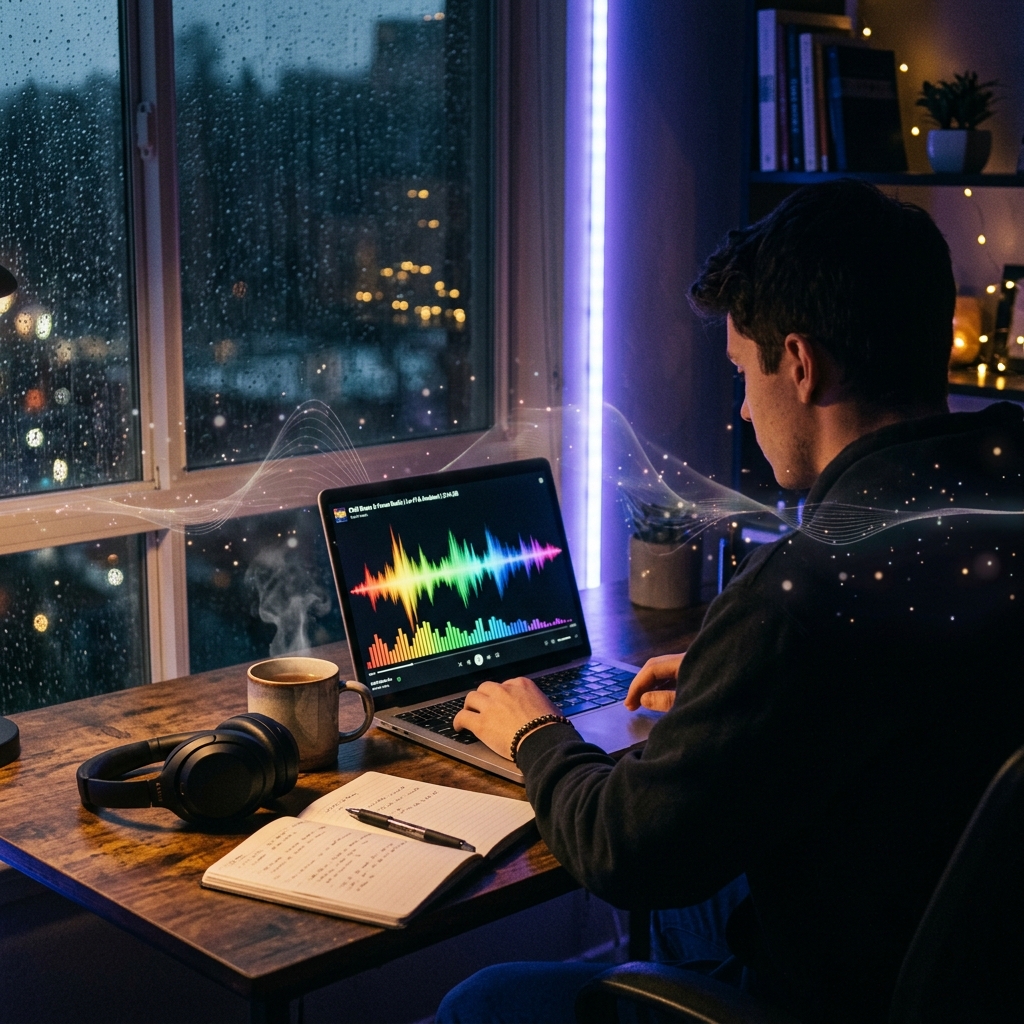
I'll be honest with you — I used to think "productivity music" was one of those wellness buzzwords that people throw around without actually testing. But then I spent three months building nRadioBox almost entirely while streaming a lo-fi hip-hop station, and the difference was real. I got more done. Faster. With fewer breaks.
So I started digging into the research to understand why. Turns out, there's more science here than I expected.
What the Research Actually Says
The most cited concept in music-and-productivity research is called the Mozart Effect — the idea that listening to music temporarily boosts spatial reasoning. It's been overhyped and partially debunked since the original 1993 paper, but it kicked off decades of research into how sound affects cognition.
What's more relevant to us is a concept called the arousal-and-mood hypothesis. A 2019 study published in Applied Ergonomics found that background music improves mood, which in turn enhances cognitive performance — particularly for repetitive or moderately complex tasks. The key word is "background." Music with lyrics, heavy beats, or unpredictable changes actively competes with working memory.
This is exactly where lo-fi and ambient music shine. They're designed to stay in the background.
"The optimal music for deep work is music that signals safety and routine to your brain without demanding conscious attention."
This is essentially what lo-fi hip-hop does by design — it's repetitive, tempo-stable, and lyrically absent.
The Specific Traits That Make Lo-Fi Work
Not all background music is created equal. Lo-fi hip-hop and ambient music have a specific set of characteristics that make them particularly effective:
- Tempo between 60–90 BPM. Research from the British Academy of Sound Therapy suggests tempos in this range correlate with reduced anxiety and improved concentration. Most lo-fi tracks land right in this zone.
- No lyrics (or heavily processed, unintelligible ones). Lyrics activate the language-processing parts of your brain — the same parts you use for reading and writing. That's a conflict. Lo-fi keeps that bandwidth free.
- Consistent, predictable structure. Your brain quickly learns that this music is "safe to ignore." It settles into the background and stops trying to analyze it.
- Mild imperfections. The vinyl crackle, tape hiss, and slight timing imperfections in lo-fi tracks are intentional. They signal an acoustic environment rather than a produced one, which is psychologically grounding.
Ambient vs. Lo-Fi: What's the Difference?
People often use these terms interchangeably, but they're different enough to matter for your workflow:
Lo-Fi Hip-Hop is sample-based, beat-driven, and usually has a warm, nostalgic feeling. It's great for coding, writing, or any task where you need low-level engagement — where the rhythm subtly structures your pacing without distracting you.
Ambient music (think Brian Eno, or modern generative ambient) is more texture than melody. It's essentially organized silence. It's particularly good for reading, research, or any task requiring deep focus where even gentle rhythmic nudges are distracting.
I personally switch between them depending on the task. Lo-fi for writing and coding, pure ambient for reading or architectural design thinking.
The Best Internet Radio Stations for Productive Work
Here are the stations I've personally spent the most time with — all available for free on nRadioBox:
-
1Chillhop Radio The gold standard of lo-fi streams. Curated beats, no ads interrupting the flow, consistent tempo around 75 BPM. Perfect for 2–4 hour deep work blocks.
-
2Soma FM: Drone Zone Pure ambient. Slow, textural, meditative. If you need to read a 50-page research paper or design something complex, this is the station. Completely non-intrusive.
-
3Soma FM: Deep Space One Electronic and ambient mixed. Slightly more dynamic than Drone Zone, great for longer sessions where pure stasis becomes boring.
-
4Radio Paradise (Mellow Mix) Curated by humans, not algorithms. The Mellow Mix is perfect for low-intensity work — thoughtful track selection, great audio quality at 320kbps.
-
5Jazz24 Classic and contemporary jazz. Research shows jazz can aid creativity — particularly during brainstorming or exploratory phases of work, not during execution.
How to Actually Use This (A Practical Setup)
Knowing that lo-fi helps is one thing. Actually implementing it consistently is another. Here's what works for me:
- Set a fixed station before you start. Don't browse or switch mid-session. The act of choosing a new track is itself a distraction. Commit to one station for the whole work block.
- Use it as an anchor. Same station, same type of work, same time of day — your brain starts associating that sound with focus. Over weeks, just hearing the music can trigger a flow state faster.
- Match volume deliberately. Around 50–65 dB (roughly conversation-level) is the sweet spot. Too quiet and it's ineffective; too loud and it competes with your thinking. Most headphone setups: somewhere around 30–40% volume.
- Take music breaks too. When you take a break, turn it off. Silence during rest makes the music more effective when you return to work.
All the stations mentioned in this article — Chillhop, SomaFM Drone Zone, Deep Space One, Radio Paradise, Jazz24 — are available completely free on nRadioBox. No sign-up, no tracking, no algorithm deciding what you should hear. Just press play and focus.
Lo-fi and ambient radio aren't magic. They won't fix a poorly structured project or compensate for genuine mental fatigue. But when the conditions for focus are already in place — a clear goal, a dedicated time block, no notifications — the right background sound can push you meaningfully deeper into flow, and keep you there longer.
The best part? It's free. Open nRadioBox, search for "Chillhop" or "Drone Zone", and give it an honest week. You might be surprised.